Capital Allocation and Risk Allocation
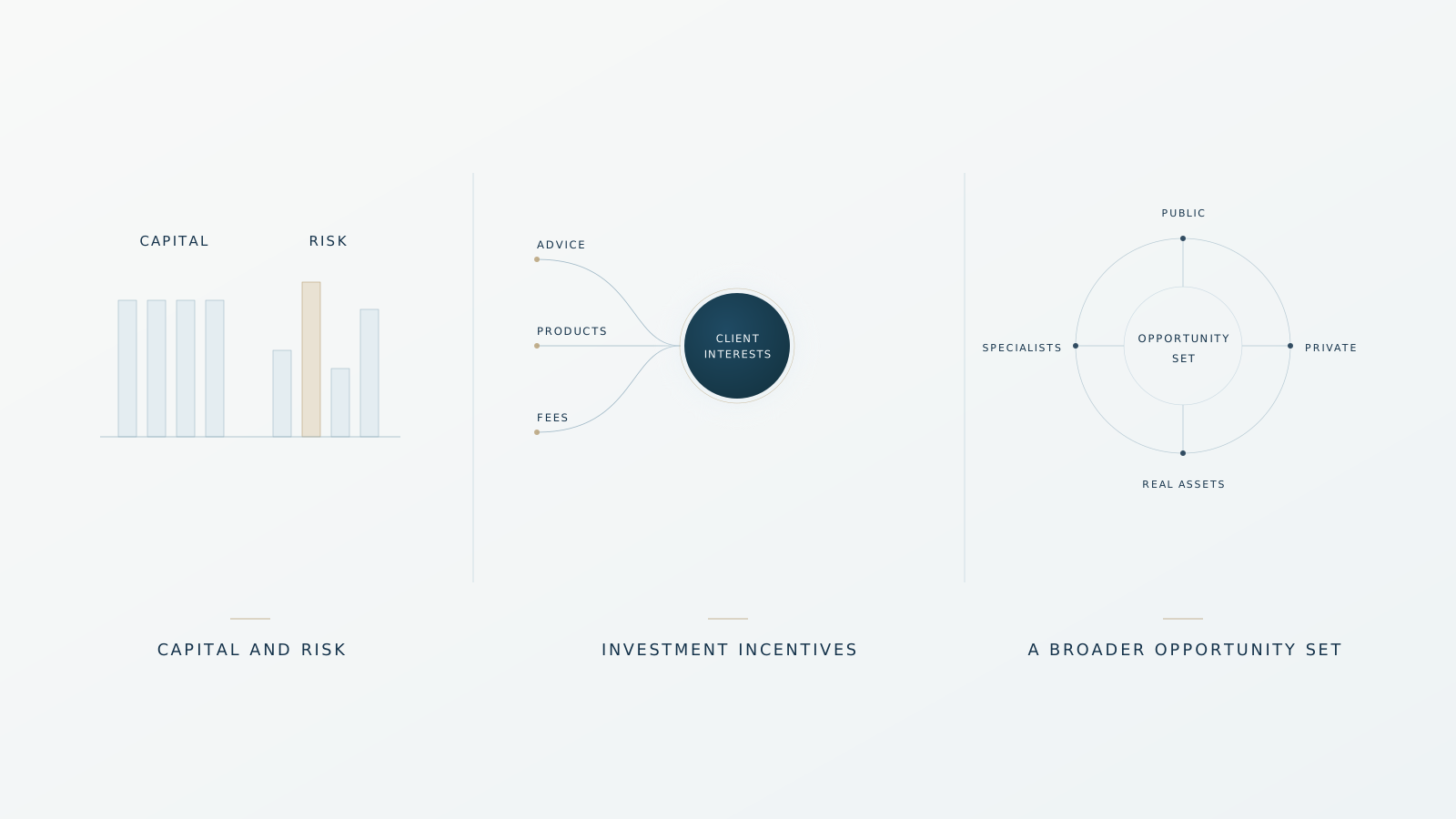
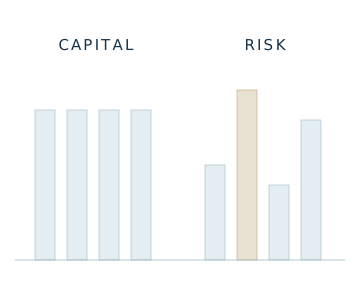
Dollar allocation alone can hide a concentration of risk. We look at what may drive the whole portfolio, including volatility, correlations and shared economic exposures.

Investment strategy
Gulfstream’s All Weather approach seeks to balance risk across asset classes rather than rely on dollar allocation alone.
Investment philosophy
True diversification isn’t simply owning more securities. It comes from combining fundamentally different sources of return whose risks respond differently across economic environments.
Dollar allocation alone can hide a concentration of risk. We look at what may drive the whole portfolio, including volatility, correlations and shared economic exposures.
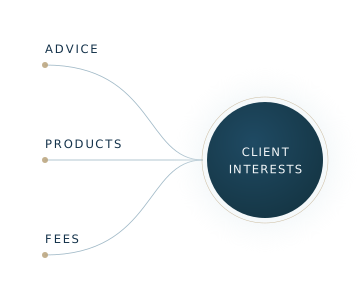
Every investment recommendation involves trade-offs, including product costs, fees and compensation. We start with the client’s objectives and describe those trade-offs plainly. How advisers get paid
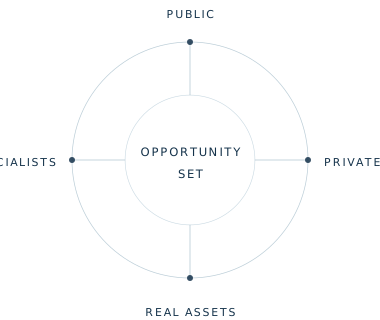
The opportunity set extends beyond familiar public securities. Private markets and specialist strategies can broaden the search, subject to eligibility, liquidity and suitability. Access to managers and private opportunities is not promised or guaranteed, can close at any time, and is available only to qualified purchasers and clients who meet the QP rules.
Incentives and client interests
Advisers and the firms they work for can be paid in several ways. Some costs are billed to you; others are charged inside a product, so they do not always appear as a line on your statement. Each structure below can create an incentive, which is a reason to ask about it, not a statement that any adviser acts on it.
Paid by a product provider or a client when a security or other product is bought or sold. This can create an incentive to recommend a purchase or a sale.
Costs charged inside a fund or product, such as expense ratios and sales charges. They are taken from the value of the investment rather than billed separately, so they reduce returns without always appearing as a line on a statement. Part may go to the firm that sells the product, which can create an incentive to recommend certain products.
An annual fee some mutual funds charge to cover marketing and distribution, part of which can be paid to the firm that sold the fund. It is included in the fund’s expense ratio, so it is not billed separately.
Payments a fund company or other product provider makes to an adviser’s firm, for example for placement on a platform or access to its advisers. This can create an incentive to recommend products from providers that make such payments.
Insurance and annuity products can pay the seller a commission, usually built into the premium or the product’s costs rather than billed separately. This can create an incentive to recommend an insurance product.
A charge for withdrawing money from some insurance and annuity products during an early period. It can be significant, and it may not show until you try to withdraw.
A percentage of the assets an adviser manages. This can create an incentive to gather and keep assets, and the fee rises and falls with the value of the account.
The adviser is paid only by clients and not by sellers of products. Fee-only advice can still involve conflicts of interest, such as an incentive to keep assets under management.
Common ways advisers can be paid. Structures differ, each has trade-offs and conflicts of interest, and one firm can use more than one. This is general information, not a description of any particular firm and not a comparison of firms.
In plain terms, a fiduciary adviser must give advice that fits the client’s goals, must not place its own interests ahead of the client’s, and must tell the client about conflicts of interest. Registered investment advisers are fiduciaries under federal law. Other financial professionals can be held to different standards, and some act under different standards for different accounts or services, so it is reasonable to ask which standard applies.
Gulfstream Capital LLC is a registered investment adviser and acts as a fiduciary to its advisory clients. In providing investment advisory services, Gulfstream is paid only by its clients, through advisory fees. It receives no commissions, product fees, revenue sharing or referral payments.
Spreading a portfolio across different sources of risk and return, rather than relying predominantly on stocks and bonds, is one way to reduce dependence on any single driver of results. Diversification does not ensure a profit or protect against loss.
A 60/40 allocation describes capital weights. Understanding its risk requires looking at the behavior of the underlying investments and how those behaviors may change together.
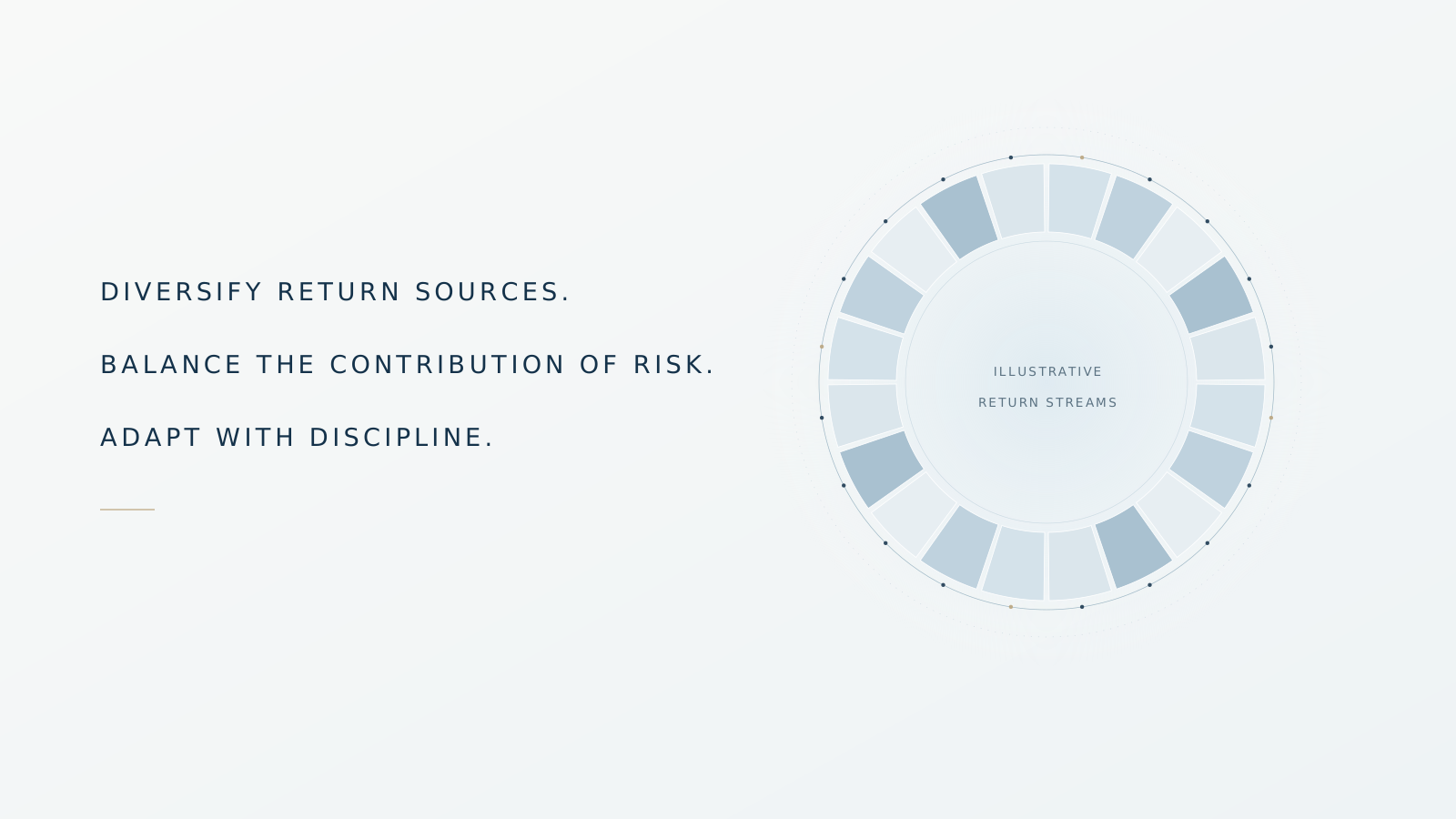
These 20 groupings are the return streams in the Gulfstream All-Weather framework. The segments are drawn equal for illustration and are not allocation weights, and not every client holds every stream. The broader opportunity-set list in the All Weather section below is a wider research universe at a different level of categorization. Neither list establishes measured independence.
Conventional allocation
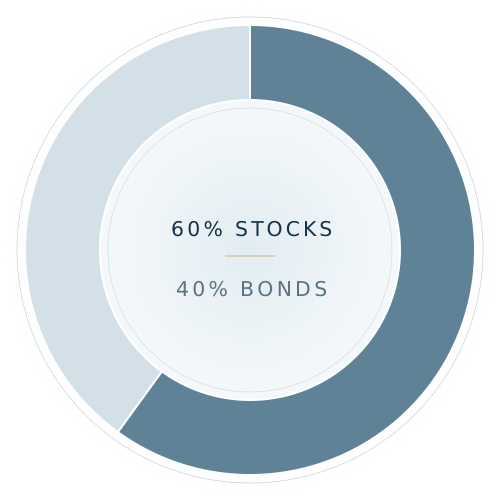
2 core asset classes
A broader framework
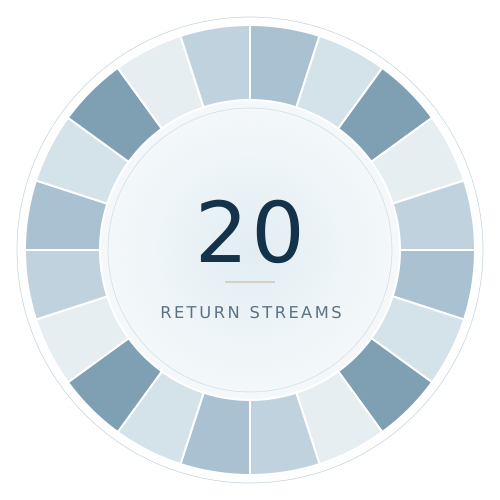
20 illustrated return streams
Diversification depends on how returns move together. The illustration below isolates the relationship between correlation and volatility under a fixed set of assumptions.
It is a hypothetical mathematical model, not actual investment performance, a backtest or a forecast.
A mathematical illustration
What matters is how the returns of different holdings move together.
Annual portfolio standard deviation

Illustrative mathematics only. Every stream has equal weight and an equal 10% standalone standard deviation, and each curve assumes a different pairwise correlation. Real portfolios do not have zero correlation among holdings, and correlations can rise in stressed markets, so the benefit shown at low correlations may not be available. These are not Gulfstream returns or forecasts, they do not describe any client portfolio, and they are not a protection against loss.
The principle behind the approach
Dalio describes 15 good, uncorrelated return streams as eliminating about 80% of risk and improving return-to-risk approximately fivefold in his public explanation of the “Holy Grail” of investing.
This is an attributed explanation of the diversification principle, not a Gulfstream performance claim. Dalio’s figures assume uncorrelated return streams. The chart above shows how quickly the effect shrinks as assumed correlation rises, and real investments may not satisfy those assumptions.
Read Dalio’s own explanation (opens in a new tab)Watch Dalio’s diversification explanation on this site
The formula is σₚ = σ × √[ρ + (1 − ρ) / n]. Standard deviation is one measure of risk; it does not describe every form of investment risk. Fees, taxes, leverage, liquidity and tail losses are not modeled. Correlations can change, including during stressed markets.
MIT portfolio theory reference · Dalio’s June 2026 discussion · Download model inputs and calculated values
Considering more than one economic environment
Gulfstream’s All Weather approach seeks to combine a broad range of differentiated return streams into a risk-balanced portfolio. No approach can ensure a profit or protect against loss in any economic environment.
The aim is to understand how investments may respond to growth, inflation and market stress, then assemble a portfolio around the risks and needs of the client.
This list of 24 categories is a broader research universe, shown at a different level of categorization than the 20 return streams in the illustration below. The categories are illustrative, not a statement that every client holds each investment or that these categories are mutually independent.
Gulfstream draws ideas from a range of firms and investment disciplines and applies its own judgment when evaluating opportunities for clients.
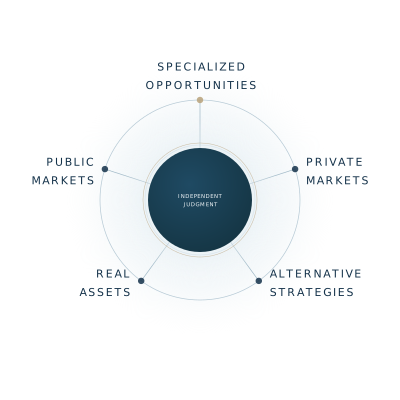
Our search spans public markets, private markets, alternative strategies, real assets and specialized opportunities. Each investment remains subject to evaluation, availability, client eligibility and suitability. Access to managers and private opportunities is not promised or guaranteed, can close at any time, and is available only to qualified purchasers and clients who meet the QP rules.
Explore our independent perspective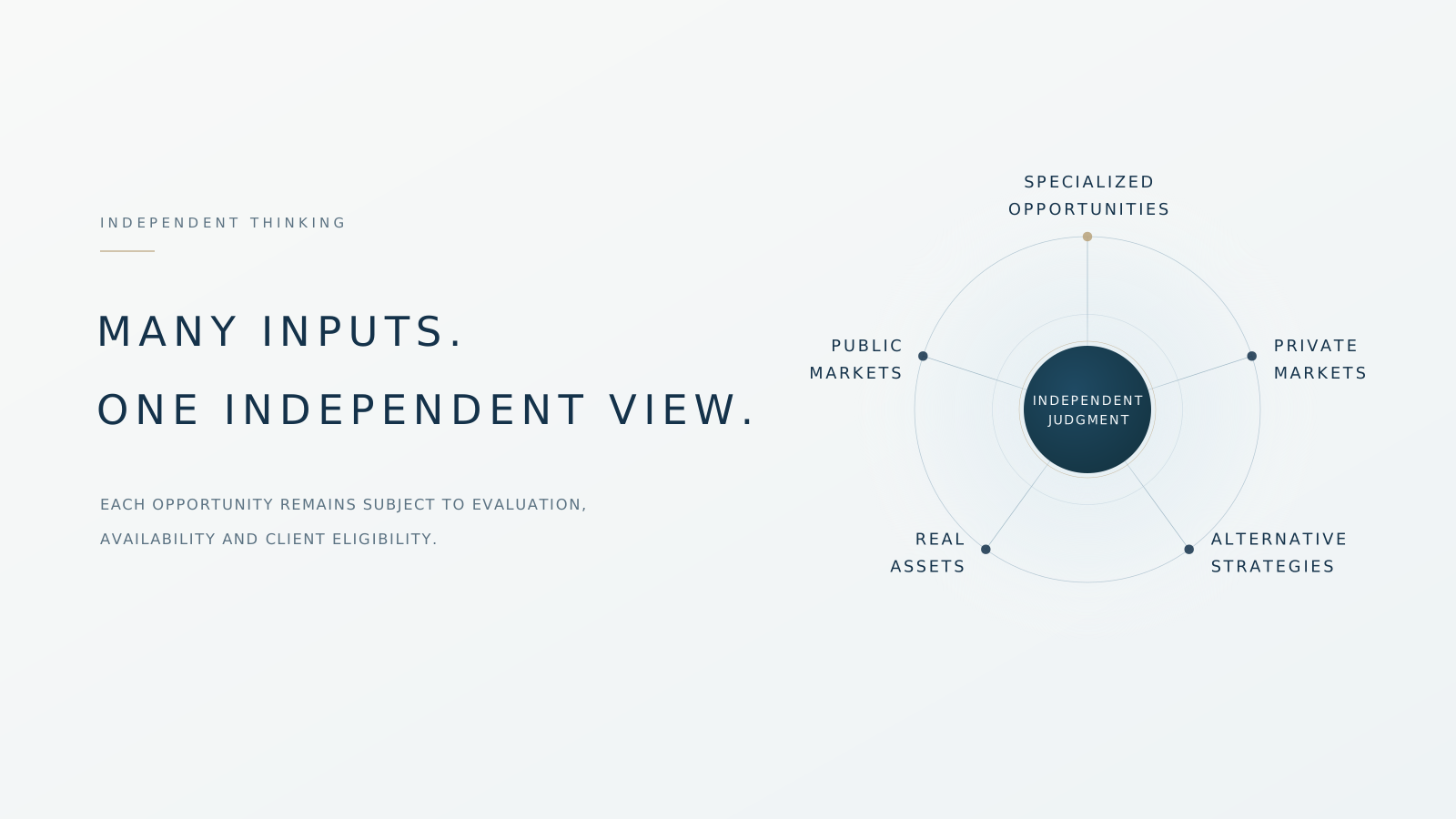
Independent thinking
A range of investment perspectives.
Independent judgment
Portfolio construction
Objectives, cash needs, time horizon and ability to accept risk.
Economic exposures, correlations, investment terms and manager discipline.
Combine investments with attention to concentration, liquidity and portfolio behavior.
Revisit the portfolio as circumstances, evidence and client needs change.