
Download the PDF edition 14 pages · charts and illustrations
Paul Tudor Jones has a gift for compressing a market into a sentence. On Tuesday, October 13, he sat down with Andrew Ross Sorkin on CNBC’s “Squawk Box” and offered several. The thread through all of them was the same: the next few months and the next year may be very different trades.
The founder and chief investment officer of Tudor Investment Corporation covered the AI boom, the supply of stock, oil and the Middle East, the U.S. deficit and, at the close, the Robin Hood Foundation he founded. What follows is our account of the interview, with short, attributed quotations and Gulfstream’s own analysis clearly marked. The full conversation belongs to CNBC, and we link to it below.
The tactical question: a run into year-end
The first question for anyone managing money in October is the fourth quarter. Does the market get a melt-up into December? Jones did not rule it out. As CNBC put it on screen, he said:
“It is possible we’ll have a run into the end of the year, but 2027 will be challenging.”
Paul Tudor Jones, CNBC “Squawk Box,” Oct. 13, 2026
That sentence frames everything that follows. Our shorthand for it is constructive into year-end, bearish on 2027. It is a view about sequence, not a single call on direction. The timing matters: the reasons he gave for 2027 are slow-moving forces that build over quarters, not weeks.
In the full interview he also raised a midterm-year seasonal pattern as context for that year-end trade. We note the topic; we do not expand on the seasonal details here.
“It still feels like 1999”
Jones repeated a comparison he has made before: that today resembles 1999, roughly a year before the dot-com peak in 2000, according to CNBC’s report. The detail he stressed this time was the split inside the market.
“It still feels like 1999, a bifurcated market: AI and not AI.”
Paul Tudor Jones, CNBC “Squawk Box,” Oct. 13, 2026
“Right now feels exactly like 1999… we’re on this path that could be great short term but may not be so great long term.”
Paul Tudor Jones, as reported from CNBC “Squawk Box,” Oct. 13, 2026
On one side are the companies seen as benefiting from the AI build-out. On the other is everything else. A market like that can rise while much of it is left behind, which is one reason a strong index can coexist with a cautious view from someone who has traded through bubbles.
He also said he had put a question about 1999 to about 200 traders. We record that he raised the question; we do not reconstruct what he asked or how they answered.
On AI itself, he offered a short observation about how the systems behave:
“you know what the output is, but you don’t know why or how you got there”
Paul Tudor Jones, CNBC “Squawk Box,” Oct. 13, 2026 · as clipped by @carm1nee (opens in a new tab)
We present that line as he said it and do not assign a broader thesis to it. Elsewhere in the interview he raised an AI scenario in which strong earnings could become a “donut.” That, too, we note only as a topic he raised, without filling in the scenario.
The 2027 call is a flows call
The headline from the interview, and the line CNBC chose for its post, was blunt:
“2027 is going to be really, really challenging for the stock market.”
Paul Tudor Jones, via CNBC
The 2027 call
"2027 is going to be really, really challenging for the stock market."
— CNBC (@CNBC) October 13, 2026
His reasoning was about supply, not sentiment. “You’ve probably got the most negative flow picture for the U.S. stock market that we’ve had, say, since 2002,” he said, according to CNBC. For most of the four-year bull market, he argued, corporate buybacks together with mergers and acquisitions reduced the number of shares available. That tailwind, in his view, is turning. The new supply he pointed to includes major AI offerings from Anthropic and OpenAI, the just-completed SpaceX offering, and secondary offerings by companies raising money for the AI build-out.
He described the arithmetic in plain terms: add up the demand from buybacks and M&A, then subtract the supply from new issuance and unlocks.
“if we sum up all the buybacks, M&A… and then I subtract from that the IPOs, secondaries, unlocks”
Paul Tudor Jones, CNBC “Squawk Box,” Oct. 13, 2026 · as clipped by @carm1nee (opens in a new tab)
That is his net-flow picture: when issuance and unlocks overtake the buyback and M&A bid, the sign flips. We do not treat third-party dollar totals for those offerings as facts; the companies’ public filings, when they arrive, will set the sizes.
His positioning was explicit. “I’ll be short the whole year. There just — there’s little value,” he said. Then he reached for history: “You had all this issuance, all these IPOs in ’98 and ’99, and really 2000, 2001, 2002.”
“Those were the easiest years to be short because you kept having these unlocks that just kept adding supply to the market.”
Paul Tudor Jones, via CNBC
What the data show
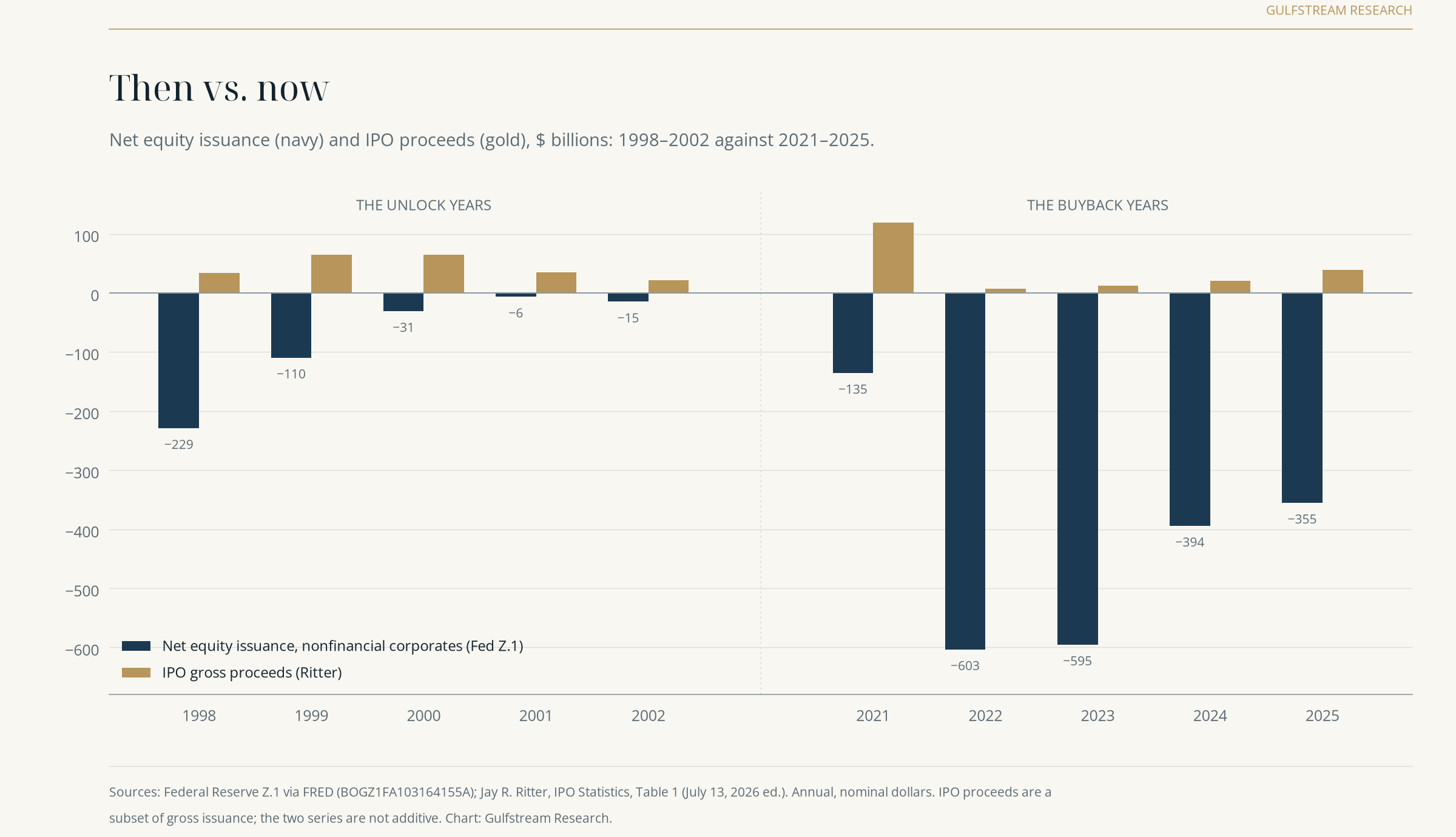
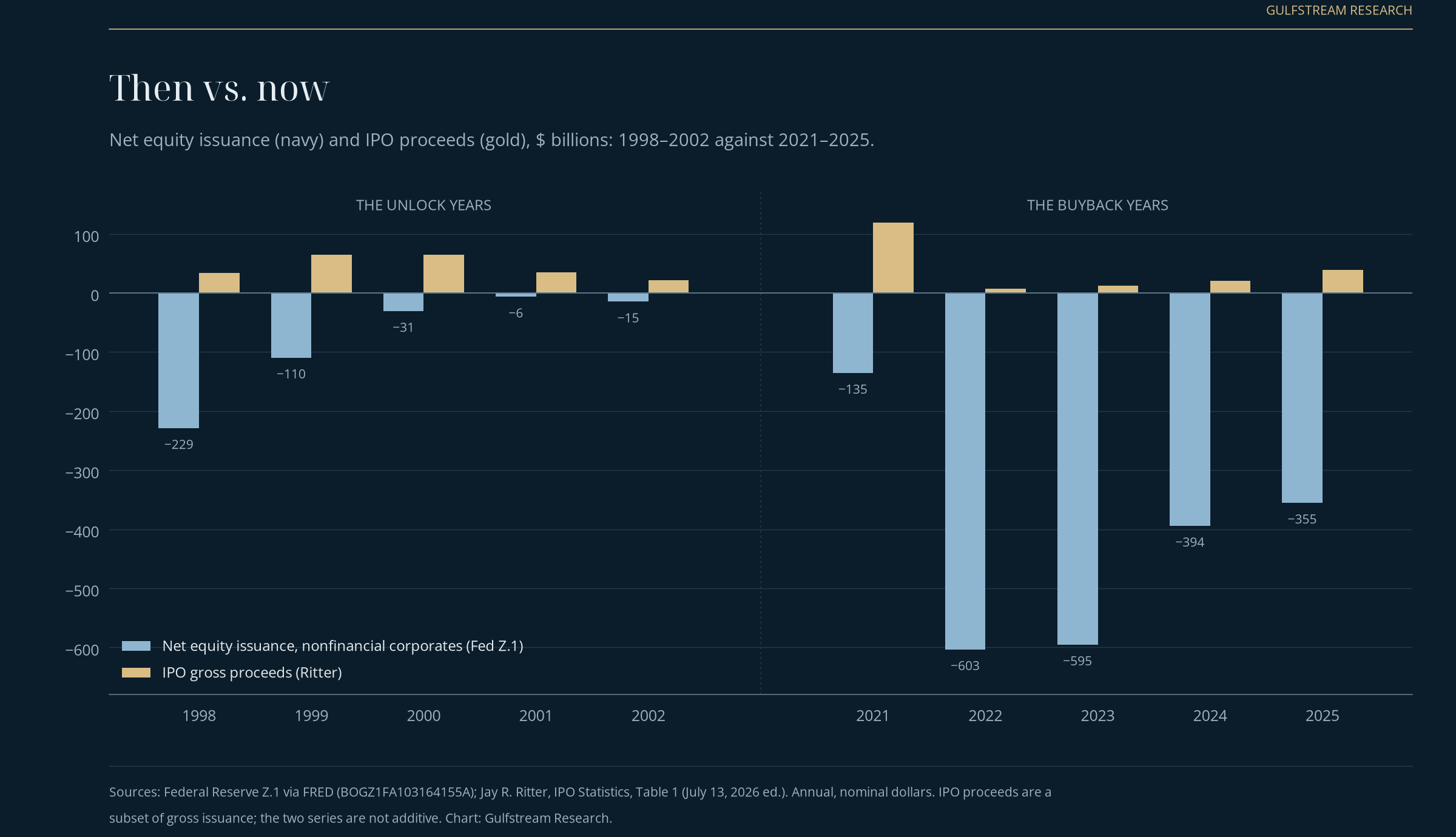
The public record supports the direction of his argument. Federal Reserve data show that U.S. nonfinancial corporations have been net retirers of stock for most of the past four decades: buybacks and cash acquisitions removed more shares than companies issued. That shrinkage was large in 1998, at about $229 billion, but it nearly vanished in 2000 through 2002, when issuance roughly offset retirements. In recent years, net retirement has run between about $355 billion and $603 billion a year.
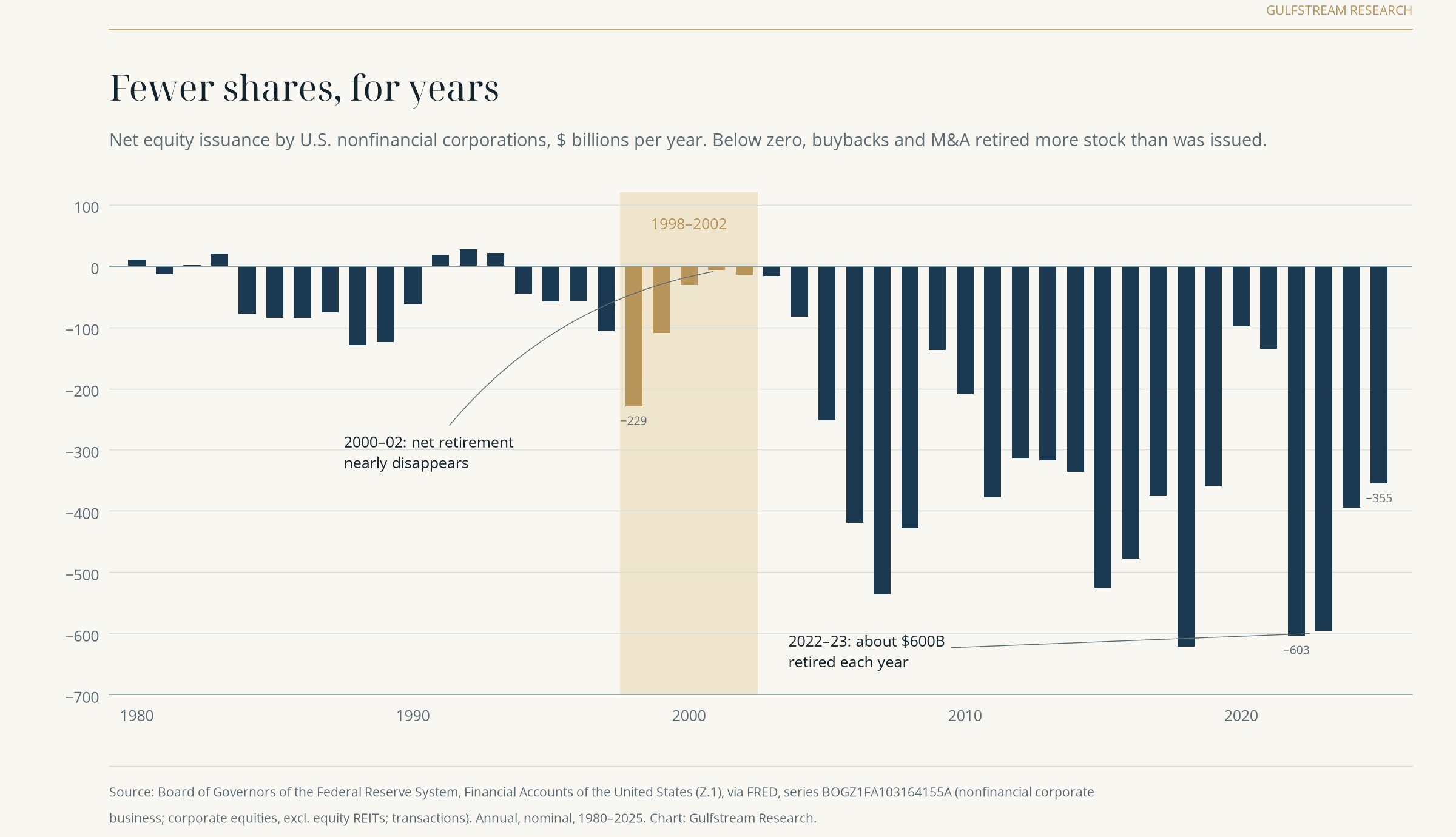
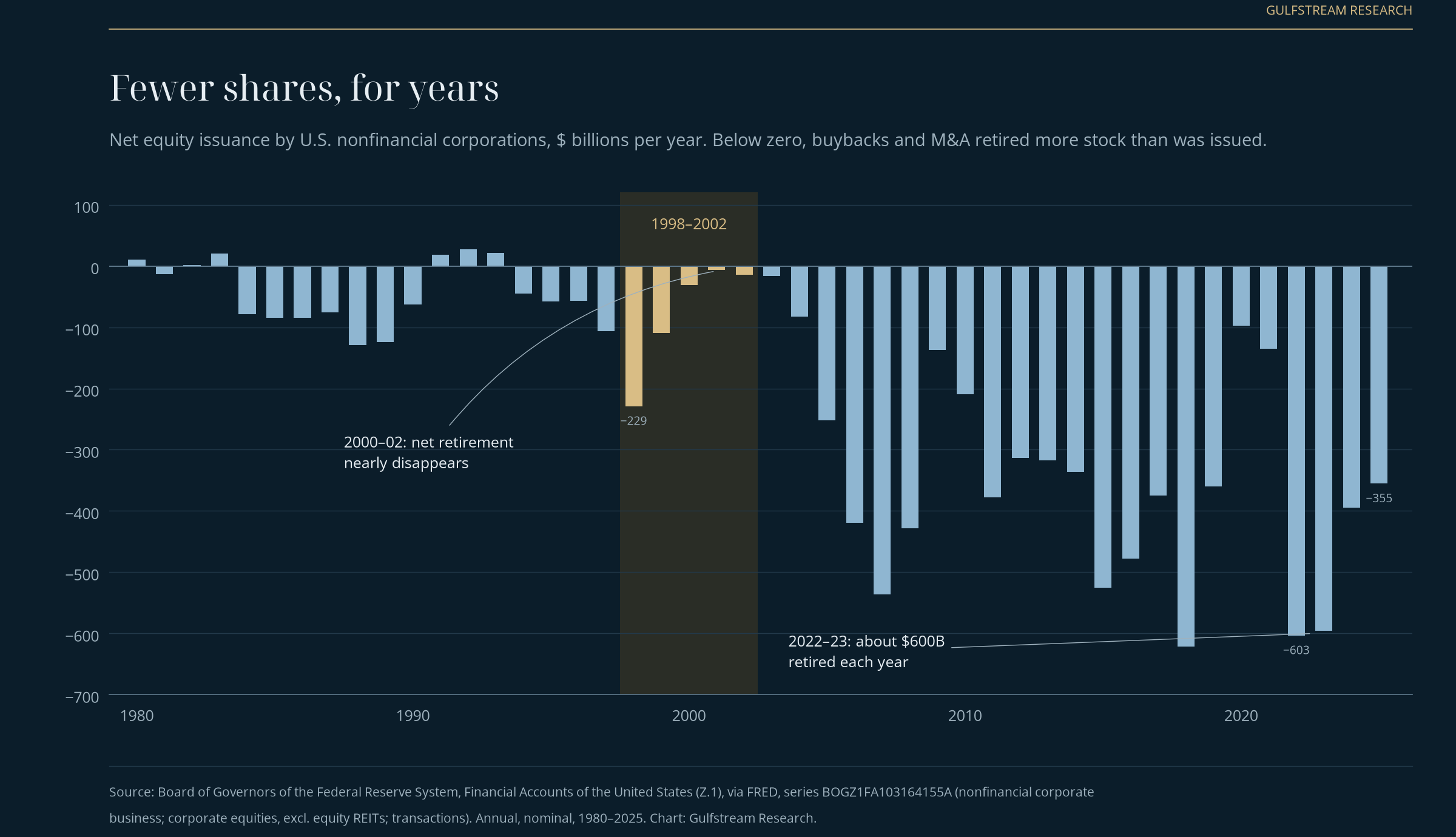
IPO proceeds tell a related story. U.S. IPOs raised about $65 billion in each of 1999 and 2000, by Jay Ritter’s count, then tapered through 2002. The 2021 boom raised more, about $119 billion, but the market had a strong buyback bid underneath it. In 2025, proceeds were about $39 billion.
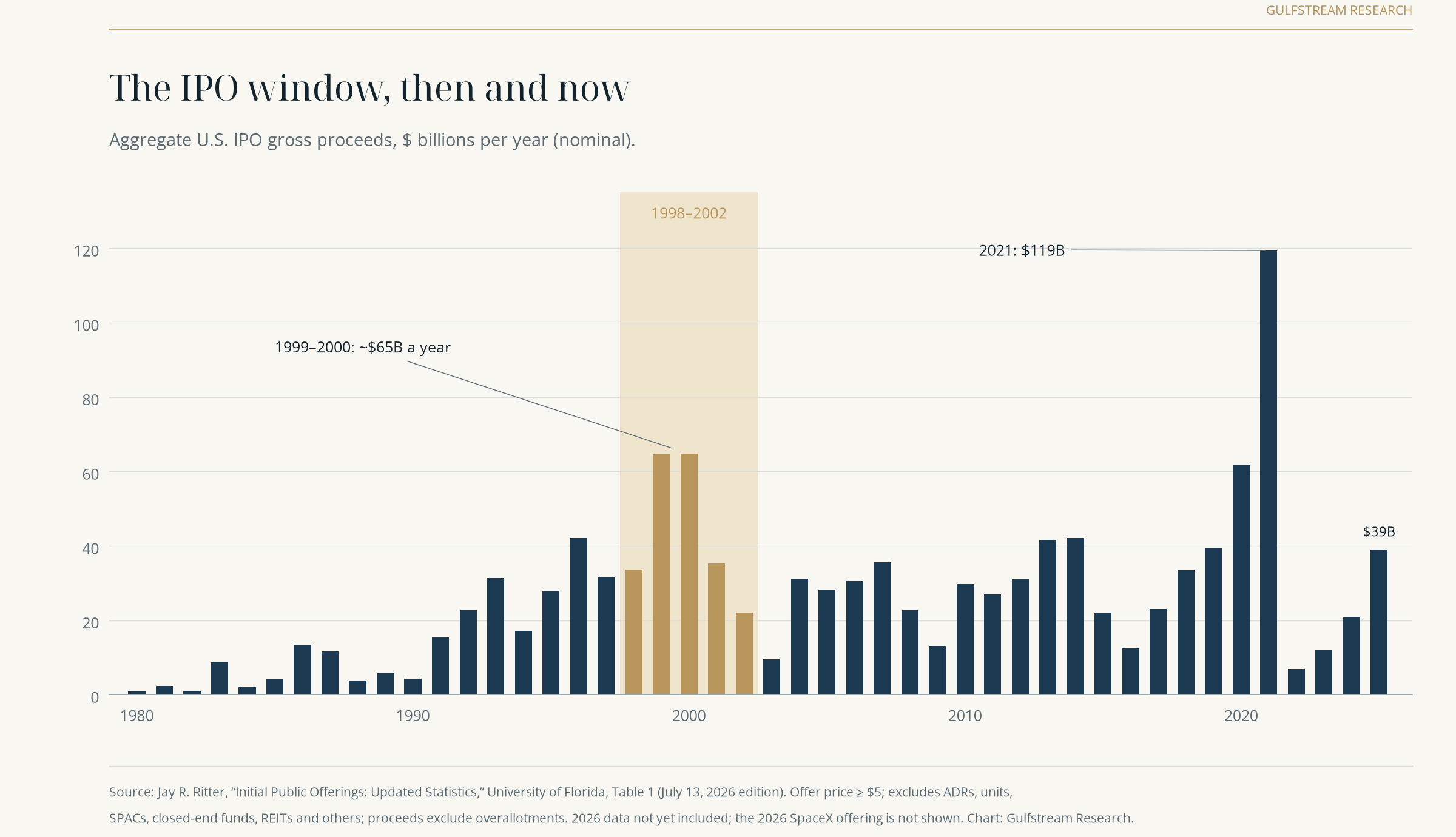
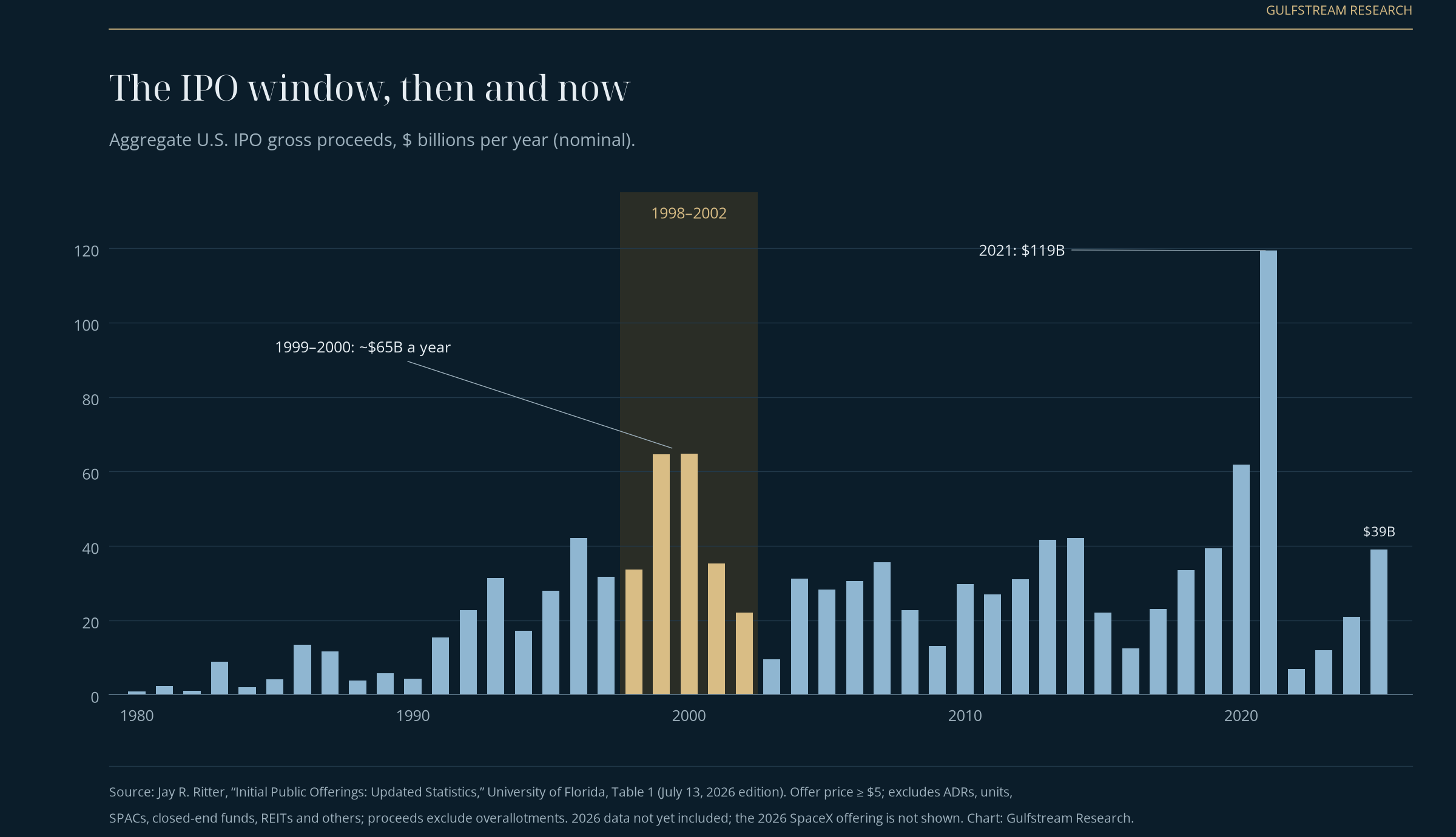
Set side by side, the two periods look different in one important way. In the unlock years of 2000 through 2002, there was almost no net shrinkage of shares to absorb new supply. In 2021 through 2025, the shrinkage was enormous. Jones’s argument is that this cushion is about to thin just as a new wave of large offerings arrives. The annual data run through 2025, so they cannot show that reversal yet. It is a forecast, and we present it as one.
Gulfstream analysis
The lock-up calendar
Jones named SpaceX, Anthropic and OpenAI as sources of new supply and drew the 1998–2002 unlock analogy. The connection below, between his “short the whole year” stance and specific lock-up dates, is our analysis, not his words.
SpaceX is the one case with public terms. Its prospectus, dated June 11, 2026, sets out when locked-up holders may sell, in the prospectus section on shares that become eligible to sell. From today, the remaining schedule allows up to about 10.6 billion shares to become eligible for sale between late October 2026 and August 2027. That includes 328.4 million on October 24, up to 1.3 billion shortly after third-quarter results, and 797.6 million on December 8. The largest single date falls in 2027: on June 12, day 366 after the offering, up to 6.4 billion shares held by Elon Musk and about 352 million held by an extended lock-up group become eligible together.
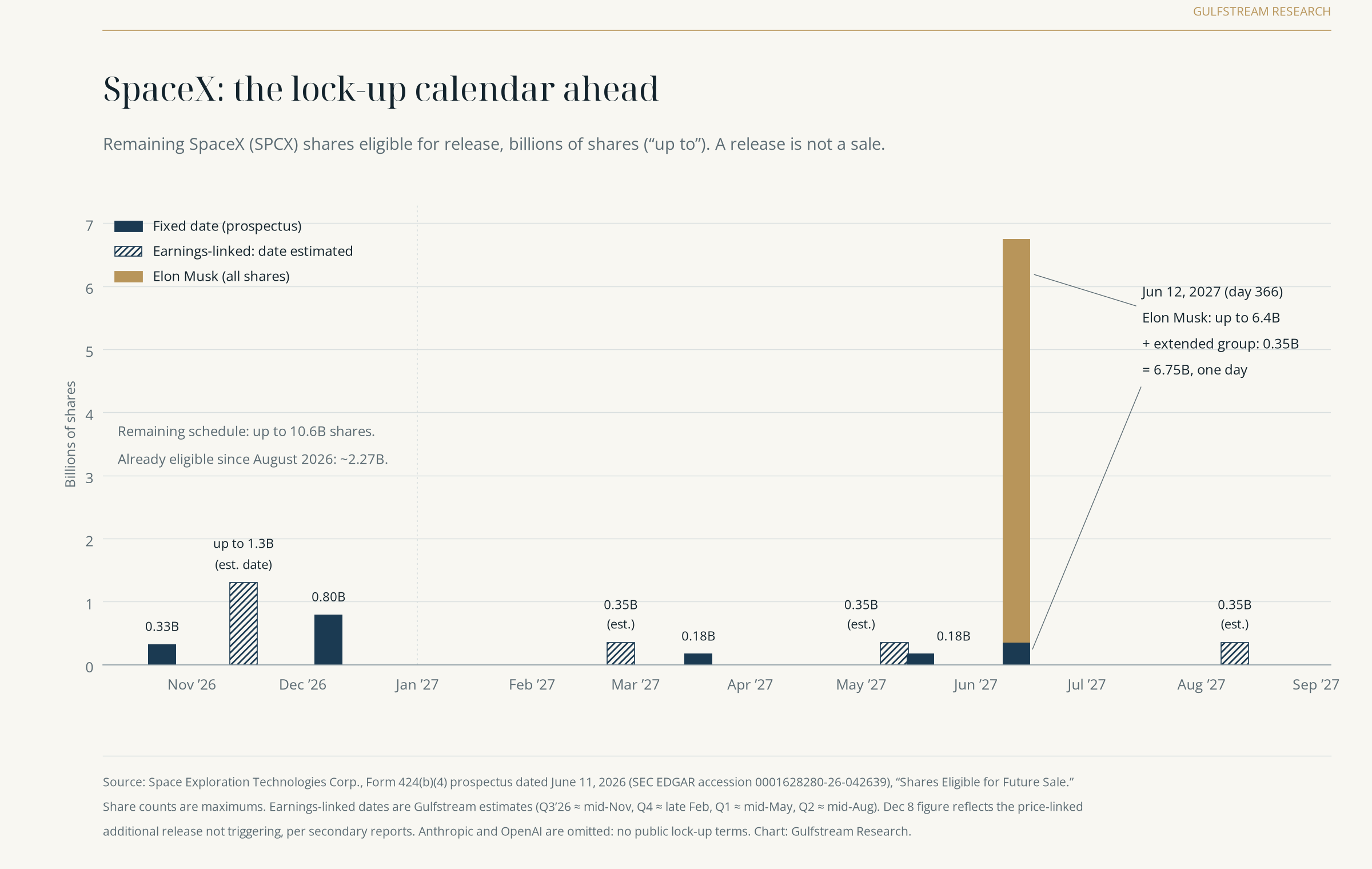
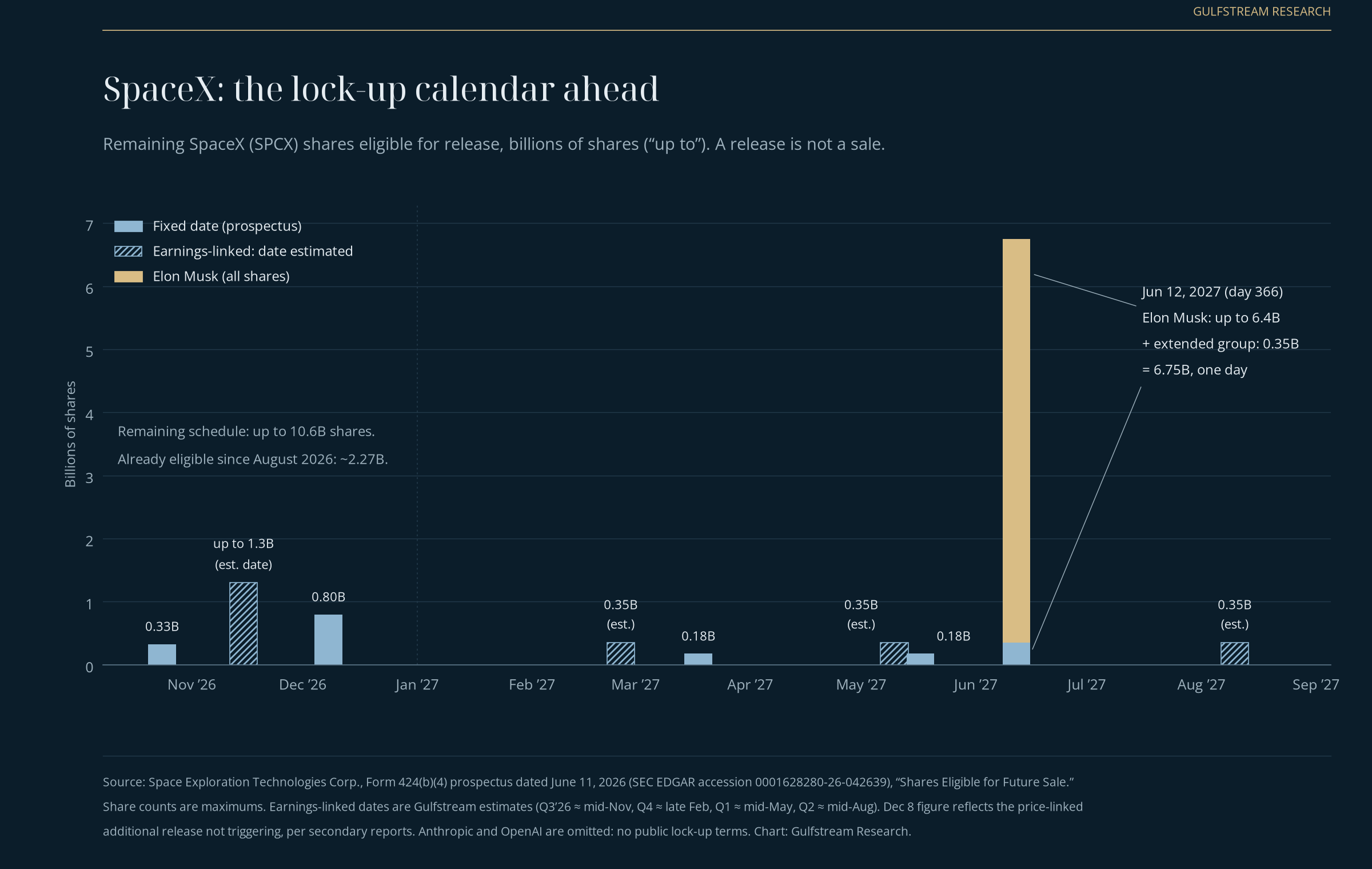
Three cautions apply. A release makes shares eligible for sale; it does not mean holders will sell. Several tranches are tied to earnings dates the company has not announced, so we have estimated their timing. And Anthropic and OpenAI have not published lock-up terms: Anthropic has said it confidentially submitted a draft registration statement on June 1, 2026, and OpenAI has been reported to have done the same. Until public filings appear, any AI-IPO unlock calendar would be guesswork, and we have left them off the chart.
Still, the shape is notable. If Jones is right that supply is the story of 2027, the busiest part of the one calendar we can read falls squarely inside that year.
Debt: the market as enforcer
Jones’s second reason for caution was fiscal. He does not expect Washington to fix the deficit on its own initiative. “We’re never going to fix these deficits until the market makes us to. It’s going to be just like 2008 and TARP,” he said, according to CNBC, referring to the Troubled Asset Relief Program, which Congress approved in October 2008 only after an initial House rejection rattled markets.
“No politician is going to voluntarily raise taxes or cut spending. They’re going to be forced to.”
Paul Tudor Jones, via CNBC
He framed the open question as one of timing: whether the market is now at the tipping point where it imposes that discipline. Asked to put a number on it, he said that “if you put a gun to my head, I’d say 60-40, we’re down that path.” In his telling, the deficit is among the dangers facing stocks, and the reckoning, when it comes, is likely to arrive through the market itself.
He also invoked a principle often cited in debates about debt, Stein’s Law, from the economist Herbert Stein. In its usual form it reads: “If something cannot go on forever, it will stop.” The law says nothing about when. That, as Jones’s 60-40 suggests, is the hard part.
Oil: long, and looking for more
Jones is long crude. “I am long oil… bullish oil… I think it can rally another $20 or $25 bucks,” he said, according to CNBC. With West Texas Intermediate trading around $92.50 that morning, CNBC noted, a move of that size would carry prices above the 2026 closing high of just under $113.
His reasoning was political as much as physical. On the U.S.-Iran conflict, he said: “If something to ameliorate the situation was going to happen, it would have happened already before the midterms.” He added that he assumes the president has a plan after the election, “because, clearly, what’s going on is untenable.”
For equity investors, the oil view and the stock view connect. If crude did rally that far, Jones said, the stock market would “absolutely, totally hate it.”
Oil
Hedge fund manager and notable commodity trader Paul Tudor Jones says oil is set to take another leg higher because of the U.S.-Iran conflict.
— CNBC (@CNBC) October 13, 2026
The prosperity of the heart
The interview closed on the subject Jones has spent decades on outside markets: the Robin Hood Foundation, which he founded. He described a city of extremes. Wealth, he noted, is at all-time highs, yet poverty in New York is the highest Robin Hood has tracked, and that without a recession.
“We’ve gotten so good as a society at measuring prosperity by net worth…”
Paul Tudor Jones, CNBC “Squawk Box,” Oct. 13, 2026
“But it doesn’t talk about the prosperity of the heart and the soul.”
Paul Tudor Jones, CNBC “Squawk Box,” Oct. 13, 2026
His measure is a different one. “It’s not by what you keep, it’s by what you give,” he said.
Philanthropy
We've gotten very good at measuring prosperity by net worth. But what about the prosperity of the heart and soul? That kind of wealth can only be built by what we give, not what we keep.
— Paul Tudor Jones (@ptj_official) October 13, 2026
Watch the full Robin Hood segment on CNBC (3:08) (opens in a new tab) Video: CNBC Squawk Box
Robin Hood describes itself as “a leading anti-poverty organization” in New York City, backing the organizations and strategies it judges most effective at advancing economic opportunity. Its annual J.P. Morgan / Robin Hood Investors Conference takes place on October 21, 2026, at Spring Studios in New York, with Jones among the interviewers. All ticket proceeds support Robin Hood’s poverty-fighting work. The conference is a closed, off-the-record event. Conference details at robinhood.org (opens in a new tab).
What we are watching
- The year-end window. Whether the “run into the end of the year” Jones allowed for materializes, and how narrow it is between AI and everything else.
- Supply. Public S-1 filings from Anthropic or OpenAI, which would make their offering sizes and lock-up terms visible for the first time.
- SpaceX dates. October 24, the tranche after third-quarter results, December 8, and June 12, 2027.
- Rates and deficits. Signs that bond markets are beginning to impose the discipline Jones expects.
- Oil after the midterms. Whether the conflict premium widens, as he expects, or a resolution arrives sooner.
Jones is known for his attention to turning points. His message this week was that the end of 2026 and the whole of 2027 may call for different postures. We think the supply argument deserves particular attention, because it is measurable, and because the calendar for it is already being written.
Watch on CNBC
Clips are published by CNBC and play on cnbc.com. We link to them and do not re-host CNBC video.
- “2027 is going to be really challenging for the stock market” (opens in a new tab) 8:10 · 2027 outlook, flows, AI
- “I’m bullish on oil, think it can rally another $20 to $25” (opens in a new tab) 5:52 · Oil, Iran, midterms, debt
- Paul Tudor Jones on the Robin Hood Foundation (opens in a new tab) 3:08 · Philanthropy
- CNBC’s full interview with Paul Tudor Jones (opens in a new tab) 25:12 · Full interview; CNBC sign-in or subscription required
Sources
- CNBC, “Squawk Box,” October 13, 2026, interview with Paul Tudor Jones by Andrew Ross Sorkin. Quotations attributed to the broadcast without a linked article are from CNBC’s on-air graphics and the segment video. Two additional short lines on net flows and AI output are from the same interview, as clipped by @carm1nee (opens in a new tab); we do not embed or re-host that clip.
- Sarah Min, CNBC, “Paul Tudor Jones says 2027 could be a really challenging year for the stock market” (opens in a new tab), October 13, 2026.
- Davis Giangiulio, CNBC, “Paul Tudor Jones is bullish on oil, says it could rally another $20-$25 because of Iran conflict” (opens in a new tab), October 13, 2026.
- Board of Governors of the Federal Reserve System, Financial Accounts of the United States (Z.1), series BOGZ1FA103164155A (opens in a new tab), via FRED.
- Jay R. Ritter, “Initial Public Offerings: Updated Statistics” (opens in a new tab), Table 1, July 13, 2026 edition.
- Space Exploration Technologies Corp., Form 424(b)(4) prospectus (opens in a new tab), June 11, 2026, SEC EDGAR accession 0001628280-26-042639.
- Anthropic, announcement of a confidential draft S-1 submission (opens in a new tab), June 1, 2026.
- Robin Hood, J.P. Morgan / Robin Hood Investors Conference (opens in a new tab), October 21, 2026.